
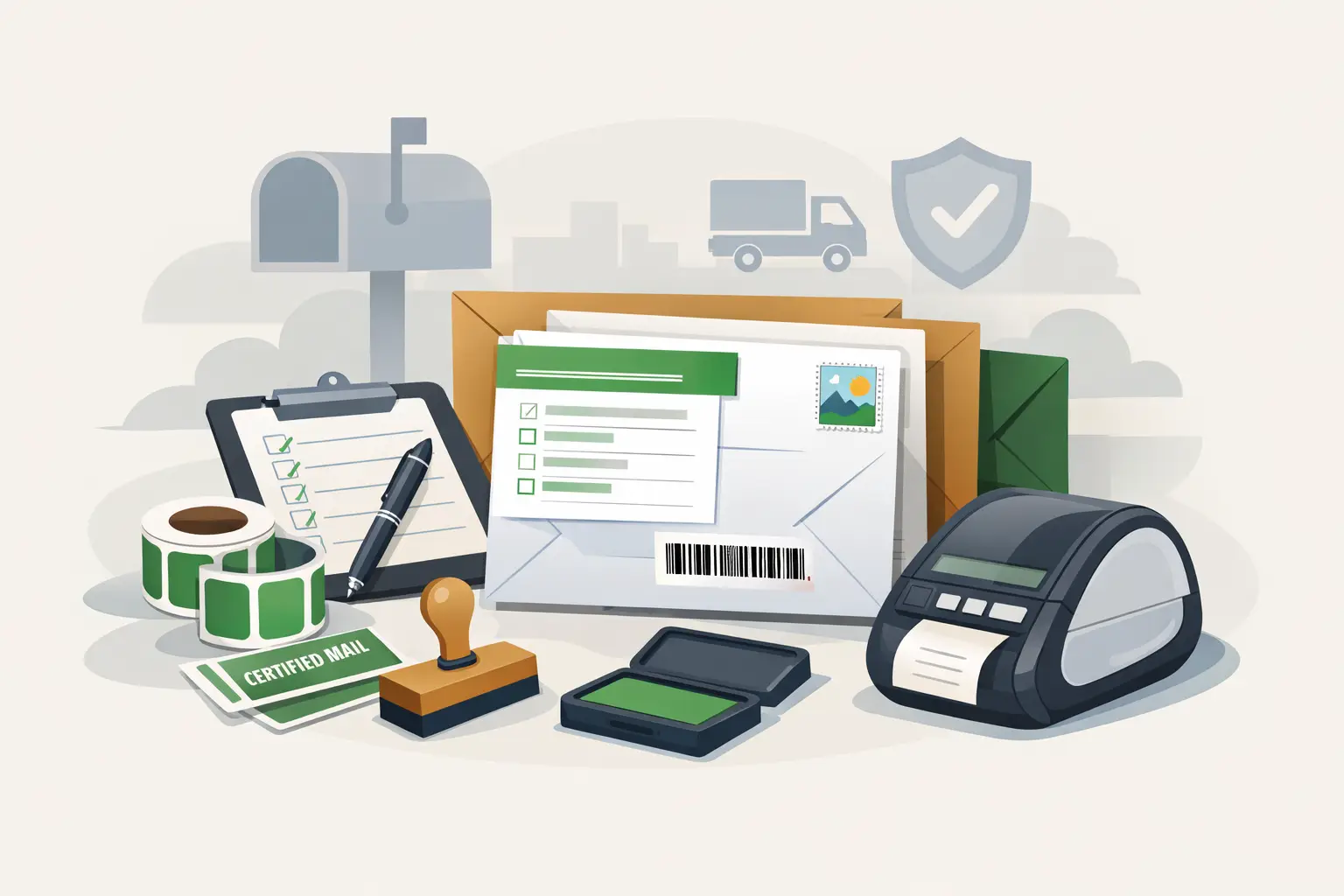
 If your office is still filling out green cards by hand, matching receipt numbers manually, and standing in line at the post office, a Certified Mail startup pack is not just a supply bundle. It is the difference between a controlled mailing process and a recurring administrative bottleneck.
For law offices, property management teams, accountants, healthcare administrators, and municipal departments, Certified Mail is usually tied to a deadline, a policy, or a recordkeeping requirement. That changes what “startup” means. You are not just buying envelopes and labels. You are setting up a repeatable process that has to hold up when someone asks for proof of mailing, proof of acceptance, tracking history, or delivery documentation months or years later.
What a Certified Mail startup pack is really for
A Certified Mail startup pack should help a sender move from ad hoc mailing to a documented workflow. In practical terms, that means it should cover three areas at the same time: physical mail preparation, USPS-compliant acceptance, and long-term record retention.
Many first-time buyers focus only on the physical pieces. They want labels, envelopes, and maybe Return Receipt forms. That is understandable, but it is incomplete. The real cost of manual Certified Mail is often not the mailpiece itself. It is the labor involved in preparing forms, the delay of visiting a post office counter, and the risk of weak records when a file needs to be audited later.
A strong startup pack reduces those problems from the beginning. It lets a small office start cleanly and gives larger operations a path to scale without redesigning their process a few months later.
The core components of a Certified Mail startup pack
At minimum, the pack should include the supplies needed to prepare Certified Mail correctly and the tools needed to document it. Those are two different needs, and both matter.
The physical side usually includes Certified Mail labels or preformatted materials, compatible envelopes, and printing support that works with standard office equipment. If users have to improvise with mismatched forms, tape, handwriting, or separate post office paperwork, the startup pack has not solved the underlying process issue.
The workflow side is where the value becomes clearer. A useful pack should support address entry, postage calculation, label generation, and mailpiece tracking in one process. It should also support USPS acceptance documentation, such as USPS SCAN forms or equivalent acceptance records, so a sender can show when items entered the mailstream. For many offices, this is more important than the envelope stock.
Then there is retention. If a system prepares the mail correctly but leaves your staff to save screenshots, PDFs, and delivery confirmations in scattered folders, you still have a control problem. Certified Mail often exists because a business or agency may need to prove exactly what happened. The startup pack should support that objective, not shift the burden somewhere else.
Why startup packs matter more for compliance mailings
Not every Certified Mail user has the same risk profile. A person sending an occasional notice may simply want confirmation that an item was delivered. A compliance-driven office usually needs more than that.
A law firm may need to show the date a demand letter was mailed. A property manager may need mailing evidence for lease notices. A tax or accounting office may need to document client correspondence. A government or administrative team may need a mailing record that aligns with internal policy. In these cases, a Certified Mail startup pack is part of a documentation system.
That is why it helps to evaluate the pack as an operational tool rather than a convenience purchase. If the materials are easy to print but difficult to reconcile, the process will break down under volume. If the records exist but are hard to retrieve, the organization will lose time every time a dispute or audit appears.
What to look for before you choose a startup pack
The first question is volume. A small office sending five to ten Certified Mail pieces a month can work effectively with a basic setup, as long as the records are organized and the label creation process is simple. An office sending dozens or hundreds of pieces needs more structure, including batch handling, acceptance reporting, and reliable account management.
The second question is who owns the mailing step. In some organizations, one administrator handles all outgoing Certified Mail. In others, multiple users across departments create mailings. That difference affects what a startup pack should support. Shared workflows, centralized reporting, and account controls become more important as more people touch the process.
The third question is what evidence your organization may need later. Some users only need tracking. Others need proof of mailing, acceptance documentation, delivery records, and Return Receipt Signatures stored together. A startup pack should match that requirement from the beginning so your process does not need to be rebuilt after a missed record request.
Physical supplies still matter, but only if they fit the workflow
It is easy to underestimate the role of the physical materials. Poorly designed labels, incompatible envelopes, or a print format that causes alignment issues can slow down even a good digital process. Offices need supplies that are straightforward to use with standard printers and mailing routines.
Still, supplies alone are not the differentiator. The stronger setup is the one where physical preparation and digital tracking are connected. When a label is created, the mailing record should already be forming. When the item is accepted, that acceptance event should be tied to the same record. When delivery occurs, it should complete the chain without requiring manual matching.
This is where product-led mailing systems have a clear advantage over buying miscellaneous forms and supplies separately. The office is not trying to stitch together a process from disconnected parts.
The trade-off between low entry cost and long-term efficiency
A basic startup pack may look less expensive up front. For occasional senders, that can be reasonable. If your mailing volume is very low and your recordkeeping needs are simple, a smaller setup may be enough.
But many organizations underestimate how quickly manual tasks compound. Address entry, form handling, trip time, acceptance receipts, tracking checks, and proof-of-delivery retrieval all carry labor cost. Once mailings become recurring, the cheaper setup often becomes the more expensive one.
That does not mean every user needs enterprise automation on day one. It means the startup pack should not trap the user in a process that becomes inefficient as soon as volume grows. Good setup options leave room for progression from occasional mailing to structured batch workflows without forcing a complete reset.
How a better startup pack reduces risk
The most practical benefit is not speed, although speed matters. It is consistency.
When staff follow the same steps each time, errors drop. Mailing records are easier to find. Tracking is easier to monitor. Questions from attorneys, managers, auditors, or customers get answered faster because the evidence is already organized.
A better process also reduces dependency on individual employees. If one person has been the only one who knows how to prepare Certified Mail manually, that creates operational fragility. A startup pack built around standardized preparation and stored records makes the process easier to transfer, supervise, and verify.
For organizations that send notices with legal or financial significance, that control is not optional. It is part of the job.
When a startup pack should include more than supplies
If your office sends Certified Mail regularly, the startup pack should not stop at labels and envelopes. It should include access to the software or workflow tools that let you create labels online, manage postage, print efficiently, track each item, and retain the mailing history in one place.
For higher-volume users, it is reasonable to expect more. Batch processing, shipment manifests, acceptance reports, and integration options can have a direct effect on labor hours and reporting quality. Those are not advanced extras for every customer, but they are essential for enterprise mailrooms, compliance teams, and administrative operations with recurring deadlines.
This is where a provider like Certified Mail Labels fits naturally for many professional users. The value is not limited to producing USPS Certified Mail labels online. It is the ability to support mailing preparation, USPS acceptance documentation, tracking, proof of delivery, and long-term record retention within one controlled process.
The best startup pack is the one you do not outgrow immediately
A Certified Mail startup pack should help your office mail correctly on day one, but it should also support the process six months from now when volume increases, staff changes, or a dispute requires historical proof. That is the standard worth using.
If the pack saves a few dollars but still leaves your team handwriting forms, chasing delivery records, or searching shared drives for old receipts, it has not solved the real problem. If it gives you compliant preparation, documented acceptance, accessible tracking, and organized proof of delivery, it has done its job.
The right setup is not the one with the most pieces in the box. It is the one that turns Certified Mail into a repeatable office function instead of a recurring interruption.
When you choose a startup pack, think less about supplies and more about control. That is usually where the time savings show up, and it is almost always where the recordkeeping gets better.